Guides
ChatGPT Images 2.5: Sunburst, Flare and AI Image Workflows
Explore ChatGPT Images 2.5, Sunburst vs Flare, editing capabilities, OpenRouter availability and how model costs relate to AI Image Agent credits.
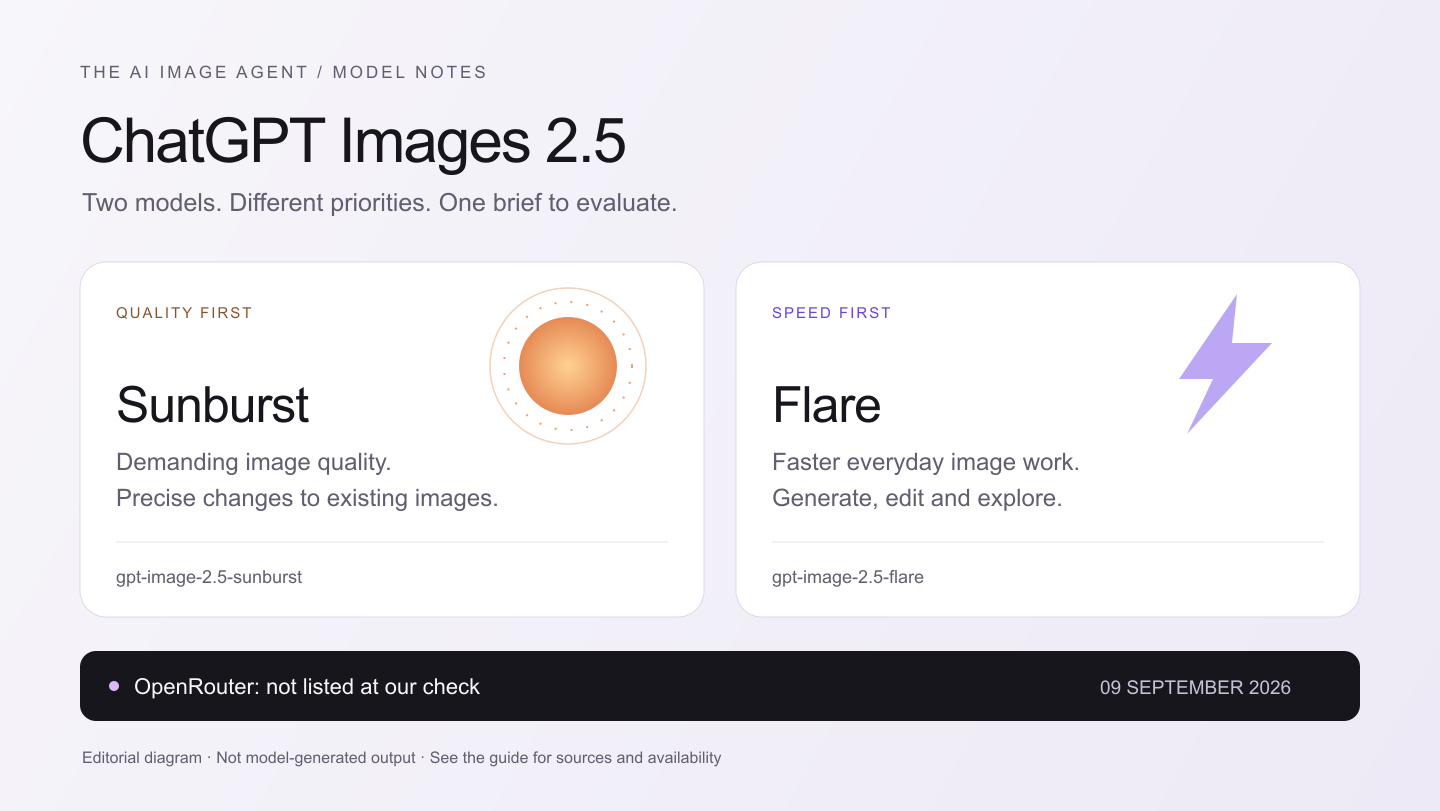
Looking for ChatGPT Images 2.5? OpenAI’s developer documentation names the underlying API family GPT Image 2.5, with two models: Sunburst and Flare. This guide explains their documented capabilities, where they could fit into an image workflow, and what is actually available in The AI Image Agent. A model release, a gateway listing and a working integration are separate steps.
What is ChatGPT Images 2.5?
For API integration, the names to look for are gpt-image-2.5-sunburst and gpt-image-2.5-flare. Both take text and image inputs and return images. OpenAI lists dated snapshots from September 8, 2026. “ChatGPT Images 2.5” is the search phrase used in this guide; it is not an API model ID, and it should not be pasted into a provider request.
A new model can improve the step that creates or changes pixels. The surrounding product still has to understand your request, decide which operations are needed, show a price, save the result and let you continue editing. That distinction explains the role of The AI Image Agent: the workflow coordinates image tools around a goal. Adding a new image model would extend that workflow, while leaving the review-and-confirm interaction intact.
Sunburst vs Flare: which model fits the task?
| Model | OpenAI’s positioning | A workflow to evaluate |
|---|---|---|
| GPT Image 2.5 Sunburst | Quality-focused generation and precise editing | A product scene where label placement and object shape need close review |
| GPT Image 2.5 Flare | Speed-focused everyday image generation and editing | Early visual directions before choosing one composition to refine |
The last column is our proposed evaluation plan, not a claim that either model has passed these tasks on this site. For a useful comparison, use the same input, brief, output dimensions and quality setting. Judge the required details first, then compare elapsed time and total billed cost. A fast result that needs three corrections may be less useful than a slower result that meets the brief immediately.
Documented capabilities and limits
OpenAI documents generation, image editing, subject preservation and transparent backgrounds for the 2.5 family. Quality options are auto, low, medium, high, xhigh and max. Custom dimensions are supported: edges must be multiples of 16, no edge may exceed 3,840 pixels, aspect ratio cannot exceed 3:1, and total pixels must be between 655,360 and 8,294,400. Outputs above 3,686,400 pixels are experimental. These are API capabilities, not controls currently exposed by this workspace.
OpenAI offers an Image API for individual generation or editing requests and a Responses API image-generation tool for conversational workflows. Direct OpenAI access can require organization verification. Neither that access nor a ChatGPT subscription establishes availability through OpenRouter. Consult the official image-generation and prompting guides linked below for the current parameter rules.
For ecommerce work, evaluate label spelling, logo geometry, edge quality, shadows and colour separately. Those are acceptance criteria, not promises of perfect preservation. Use the AI product photo workflow to understand how preparation, scene composition and final export fit together. If a job only needs a clean cutout, the background removal guide may be the more direct starting point.
Prompt examples for generation and careful edits
These original briefs illustrate how we would evaluate the models. They have not been run on Sunburst or Flare. Write down the visible result and the details that matter before generating, so you have something concrete to check afterward. A pleasing image can still be the wrong result if the bottle shape or a required word has changed.
- Product edit: “Use the attached bottle as the subject. Replace the kitchen background with a pale stone tabletop and soft morning light. Keep the bottle silhouette, cap colour and every label character unchanged. Add a natural contact shadow. Do not introduce other products.”
- New composition: “Create a landscape editorial image of an unbranded orange glass vase beside folded linen. Place the vase in the left third, with empty space on the right for a headline added later. Use soft side lighting and a restrained cream background. No text or logos.”
- Follow-up edit: “Change only the background from cream to pale blue. Preserve the vase position, reflections, linen folds and crop. Keep the light direction consistent with the previous image.”
If you need help turning a rough idea into a brief, start with the image prompt generator. If you already have a visual reference, describe an image as a prompt to identify its composition, light and style. Review those descriptions before using them: they are a starting point for your direction, not a guarantee of an exact recreation.
Is ChatGPT Images 2.5 available on OpenRouter?
We checked OpenRouter’s public models endpoint on September 9, 2026 at 03:02 UTC. The response contained 431 models. No model ID, name or description matched GPT Image 2.5, ChatGPT Images 2.5, Sunburst or Flare. This is a dated catalog check; availability may change after it.
| OpenRouter model found | Image family described by OpenRouter | GPT Image 2.5? |
|---|---|---|
| openai/gpt-5.4-image-2 | GPT Image 2 | No |
| openai/gpt-5-image | GPT Image 1 | No |
| openai/gpt-5-image-mini | GPT Image 1 Mini | No |
The site therefore has no executable GPT Image 2.5 route today. The informational model cards do not enable generation, and mentioning the model in a prompt does not select it. Before adding a route, we need a matching gateway listing, account access, a working image response and verified usage costs. An older model with a similar name would not satisfy that requirement.
API pricing and AI Image Agent credits
OpenAI’s model pages currently list the same token rates for Sunburst and Flare. These are direct OpenAI API rates, not an OpenRouter quote or a fixed cost per image. The model documentation also cautions that the GPT Image 2 calculator does not estimate GPT Image 2.5 token consumption.
| Token category | USD per million tokens |
|---|---|
| Text input | $5.00 |
| Cached text input | $1.25 |
| Image input | $8.00 |
| Cached image input | $2.00 |
| Image output | $30.00 |
To illustrate the arithmetic only: 1,000 uncached text tokens, 2,000 uncached image-input tokens and 4,000 image-output tokens would cost $0.141 at those rates. These token counts are hypothetical, not a measured image request. They exclude any additional workflow or gateway costs. The same token price does not establish the same final cost across models, quality settings or reference images.
No GPT Image 2.5 credit rate is offered on this site yet. We price completed outcomes, so a future quote must cover the whole task, including generation, checks and a bounded allowance for retries. Our pricing plan is to measure costs separately for each model and quality level, then show the complete credit amount before confirmation. Higher-cost settings must fit that approved budget rather than add an unexpected charge afterward.
The existing image credit prices and subscriptions continue to apply to supported workflows. They should not be read as Sunburst or Flare prices. Planning and revising a plan are free of image-credit charges; paid Agent execution reserves the result’s credits when the run starts. Failed Agent runs return those credits under the current billing rules. The current plan card shows the proposed steps; use Pricing to check the published result rates.
How this connects to your current image workflow
You can prepare and run a supported task now without waiting for another model. The following steps describe the existing product, not a preview of a GPT Image 2.5 integration. An Agent plan needs an eligible signed-in subscription and enough credits to execute. Direct tools have their own allowances, which are shown in the workspace.
1. Describe the outcome
Open the workspace and explain the finished image. Specify what must change and what needs to stay the same.
2. Add a reference
Attach an image if the task needs one. Use your actual source so the plan can be grounded in the material you want edited.
3. Review and confirm
Read the proposed steps and check the result rates on Pricing. Use Change request to revise the plan, then Confirm and run when it is ready.
4. Check the result
Inspect the details you asked to preserve. Download the result or use Edit this result to start a follow-up request.
Start in the Agent editing workspace when the job involves several operations. For a finished composition that only needs larger dimensions, read the image upscaling guide. The useful choice is the workflow that gets your actual source to the required deliverable with a reviewable scope and price.
Questions about ChatGPT Images 2.5
- Can I select Sunburst or Flare here? No. They are documented in the model guide but are not executable options in this workspace.
- Is GPT-5.4 Image 2 the same model? No. Its OpenRouter description names GPT Image 2, not the 2.5 family.
- How many credits will a 2.5 image cost? A final amount has not been set. Provider availability, measured usage and the complete outcome budget must be established first.
- Are the cover image and prompts benchmarks? No. The cover is an editorial diagram, and the example prompts are proposed test briefs. No GPT Image 2.5 sample output is presented here.
Tools this guide is about
- Home
- Image Agent Workspace
- AI Product Photo GeneratorStart from the scene you want, not from an upload box. Pick a setting here, add your product photo in the workspace, and get four variations sized for where you sell.
- Image Prompt GeneratorWrite one line. Get five prompts that each move a different axis — style, lighting, camera — so you can see which direction you actually wanted.
- Pricing